Royal Caribbean is threatening the tiny town of Rockland, Maine after it decided to increase its cruise ship fee to $6 per passenger.  Royal Caribbean wants the fee to stay at $1.

The AP is reporting that Rockland (population 7,000) increased its head tax to help reasonsbly compensate the community for the substantial costs imposed on town’s infrastructure by cruise ship visits.

Royal Caribbean Cruise - Tax - Rockland MaineRoyal Caribbean told the Maine Public Broadcasting Network that the fee increase "is excessive and ill timed given current economic conditions."

The giant cruise line is threatening that the higher fee will jeopardize a port of call by the Jewel of the Seas, which is scheduled to arrive in October. 

Other ports in Maine charge higher fees, such as Portland, Maine which charges $9 per passenger.  Alaska charges $34.50 per person, down from $50.

Cruise lines like Royal Caribbean pay zero federal taxes on the $6,000,000,000 (billion) in cruise fares from mostly U.S. tax-paying citizens – by flagging their cruise ships in foreign countries.  And there is no doubt that the cruise lines are making money hand over fist.  Forbes announced three cruise tycoons as some of the richest people in the world – "Cruise Line Fat Cat Billionaires."

So just $1 a person?  Or Royal Caribbean will pull its Jewel of the Seas out of Rockland?  

Rockland should call the city managers in Norwich, England whose facilities have been inundated with sick passengers returning from the norovirus contaminated Jewel of the Seas for the past month, and ask them about the real costs associated with entertaining such huge cruise ships. 

Scare tactics.  What a basis for a meaningful relationship.

Last week was another rough week for Royal Caribbean. 

First there were repeated outbreaks of the nasty norovirus aboard the Jewel of the Seas which sickened hundreds of unsuspecting passengers. Then there was the embarrassment of a Royal Caribbean employee with a criminal record stealing private information from Royal Caribbean computers regarding Royal Caribbean customers so her career-criminal-of-a-husband could break into their homes while they were on Royal Caribbean cruises.  And finally there was a sexual pervert molesting a 6 year old child in the kid’s H20 WaterZone aboard Royal Caribbean’s Independence of the Seas.    

Roya Caribbean Cruise - PR - Public Relations - Press Statement - Crime - Norovirus For those in the know in Miami, Royal Caribbean is consider to the black sheep of the cruise industry.   Ask insiders at Carnival, NCL and the smaller cruise lines like Oceania, Regent Seven Seas, and Silversea Cruises for a quote?  They will whisper under their breath – only at Royal Caribbean could this happen.   

These stories caught Royal Caribbean flat footed.  Its PR people (which the cruise line calls the "corporate communications" department) were late to the stories and ended up issuing the usual corporate sounding PR statements which made them sound guilty as hell:

In response to the norovirus outbreaks, the Royal Caribbean PR people issued this statement: "At Royal Caribbean International, we have high health standards for all our guests and crew . . ."

This statement came after its own employee burglarized the homes of local Florida citizens who were cruising on Royal Caribbean ships: "Royal Caribbean does not tolerate any form of criminal activity in its workforce or operations . . . " 

And finally this one after the sexual abuse of a child in the children’s water zone on its cruise ship: "Royal Caribbean maintains a zero tolerance policy regarding any criminal activity onboard our ships . . ." 

Gobbledygook!

Royal Caribbean’s PR statements about norovirus and crime are corporate double-talk.

For example, the cruise line’s "zero tolerance" program began as a public relations stunt ten years ago after it hired outside consultants to study its high rate of sexual assaults.  After the experts told Royal Caribbean that it had a problem because of the frequent sexual crimes on its cruise ships, the cruise line ended its study, rejected the experts’ recommendations, and adopted a marketing strategy where it claimed that it had "zero tolerance" for crimes.  This was the same year it pled guilty to multiple felonies for making false statements to the U.S. Coast Guard and the U.S. Attorney’s Office about environmental crimes.   

Since then Royal Caribbean’s CEO, Richards Fain, tells the company stockholders each year that crime on Royal Caribbean ships is "rare" when the cruise line’s own experts concluded long ago that crimes against passengers is "routine."  

As far as the "high health standards" go, take a minute and read the 46 comments by sick passengers who just got off Royal Caribbean’s norovirus contamnated cruise ship.  

Out of this gobbledygook comes a clear message: you can’t trust what Royal Caribbean says.


*The word "gobbledygook" comes from Maury Maverick, a Texan lawyer who served as a Democratic Congressman and the mayor of San Antonio.  He used the word in the New York Times Magazine in 1944 referring to a turkey, “always gobbledy gobbling and strutting with ludicrous pomposity.”


Photo Credit:      The Consumerist    Don’t miss reading "Royal Caribbean Caught Infiltrating Review Sites With Viral Marketing Team."

Celebrity Cruises is again reporting that at least 55 passengers have fallen ill on its Mercury cruise ship with norovirus-like symptoms. 

In a prior article we questioned: Will the Celebrity Mercury Infect Another Round of Passengers?

Here We Go Again

A local news source in South Carolina, the Palmetto Scoop, reports on the latest cruise Cruise Ship Norovirus - Sick Passengersship sickness in an article entitled "Sickness Again Plagues Charleston Cruise Ship:" 

The crew of the Celebrity Cruises “Mercury” ship, which docks in Charleston, thought they had thoroughly sanitized the vessel after nearly one-quarter of the 1,800 travelers came down with a norovirus-like illness on their last voyage. 

Turns out they didn’t do a very good job.

The Mercury ship set sail from Charleston on Saturday and within days, dozens of passengers became sick.  As of Friday, 55 of the 1,880 travelers had fallen ill with the norovirus stomach bug.

Norovirus is a disease common to cruise ships because it is highly contagious and affects confined communities. The unpleasant disease usually runs its course after a day or two and spreads through food, water, or person-to-person contact.

Celebrity Cruises has based the Mercury in Charleston, South Carolina where officials have reported twice as many cases of norovirus as normal this winter. The Associated Press reports that the virus may have come aboard the cruise ship by passengers, crewmembers or infected supplies.


https://youtube.com/watch?v=jzGu3fok3mI%26hl%3Den_US%26fs%3D1%26rel%3D0


Celebrity Cruises is owned by Royal Caribbean Cruises whose cruise ships have experienced a large number of norovirus cases this season. 

Other Royal Caribbean Cruise Ships Experiencing Widespread Illness

The Huffington Post reports that at least 310 passengers were sickened aboard Royal Caribbean’s Vision of the Seas. A spokeswoman for the Brazil’s National Agency for Sanitary Vigilance stated that the sickness was caused by "some kind of food poisoning aboard"  the cruise ship.  Earlier this week, Brazil ordered all 1,987 passengers and 765 crew members to remain on the ship anchored near Rio de Janeiro.  The passengers were just recently permitted to leave the ship. 

Royal Caribbean’s Jewel of the Seas and Celebrity Cruises’ Millennium cruise ships have also reported of a large number of ill cruise passengers. According to the Centers for Disease Control (CDC) 102 passengers and 14 crewmembers suffered gastrointestinal illness on the Jewel of the Seas, and 157 passengers and 23 crewmembers became ill on the Millennium

You can track cruise norovirus cases via the CDC has a web page which tracks "Outbreak Updates for International Cruise Ships," although not all cruise illnesses are required to be reported to the CDC.  For example, the recent outbreak of illness on the Vision of the Seas was not reported to the CDC. 

For other information about norovirus on cruise ships, consider reading Cruise Ship Norovirus – Clean the Damn Toilets!


Video:          WCSC (AP)

Haiti is in turmoil. Over one hundred thousand Haitians lay dead in the streets and rubble of Port au Prince alone.  The anguish and suffering of millions overwhelm our senses. 

There is a raging debate taking place in U.S. newspapers, television and the internet, as well as in the comments to this blog. Is it appropriate to sail into the idyllic port of Labadee, Haiti on a pleasure cruise when the dead remain unburied and the impoverished country writhes in chaos?

You must have conflicted feelings if you have a ticket on a Royal Caribbean cruise to the Caribbean this month.

But the fact of the matter is that the cruise line made a decision to sail to its “private destination” of Haiti irrespective of the public debate. In an interview yesterday, the President of Royal Caribbean, Richard Goldstein, explained to National Public Radio (“NPR”) that the decision to continue business as usual in Haiti was a “pretty easy decision . . . a no-brainer.”

A "no-brainer?"  Did he really say that?  Believe me, this is not a corporation racked with a social conscience.

But in the next ten days, almost 20,000 Americans – most of whom have a conscience as well as a brain – will sail to Haiti on Royal Caribbean cruise ships:

On January 22nd the Jewel of the Seas will sail to Labadee, Haiti with 2,501 passengers. On January 23rd the Independence of the Seas will sail to Labadee with 4,370 passengers. On January 24th the Freedom of the Seas will arrive with 5,400 passengers. On January 30th the Navigator of the Seas will arrive with 3,114 passengers. And on January 31st the Liberty of the Seas will end the month with 4,375 passengers.

So those of you who are cruising to Labadee in the next 10 days acutely realize that you have already paid for your cruise. Unless you cancel, and believe me you will lose your fare because in the eyes of the cruise industry there is no such thing as a conscientious objector, you will be in Haiti shortly. Whether you like it or not.

So what can you do? How can you make a difference?

Royal Caribbean issued high profile press releases about donating a million dollars over the next year or so based on the net proceeds of the money you spend in Labadee. So if you spend $170 on a zip line and a jet ski – and the cruise line figures that its costs are around $160 for these Labadee - Haiti - Royal Caribbean Private Destinationservices – it may donate $10 to Haiti. Coming from a foreign corporation which does not pay U.S. taxes and collects $6,000,000,000 (billion) from tax-paying U.S. citizens each year? 
Not too impressive.

Especially compared to Carnival, with no relationship whatsoever with Haiti, which pledged to donate $5,000,000 – $4,000,000 more than Royal Caribbean.  

Royal Caribbean also released photographs (in the Nation of Why Not?" blog) and video to the media showing a small number of pallets of water and meager food supplies. 

Not too impressive. 

So its up to you to make a difference. Try and think outside of the box.

Here are some suggestions:

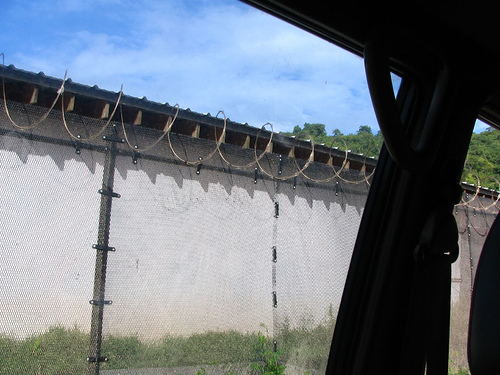
1. Don’t pay for the zip line, or jet skis, or para-sailing when you arrive in Labadee. Royal Caribbean will take most of your money and eventually send a pittance to Haiti after deducting its “expenses.” Instead, put $100 in an envelope and take it to the 12 foot fence which keeps the Haitians away from you and their beach. Hand the envelope to the people who are gripping the fence and desperately staring into the beach at you. Tell them to use it for their families and friends down south. If all 20,000 of you do it – that’s $2,000,000 by the end of the month.

2. Bring a case of water with you. Jam it into your duffel bag. Bring it into Labadee. Throw it over the fence. If all 20,000 of you do it, that’s 20,000 cases – or close to 500,000 bottles of water.

3. Pull out your cell phone now. Text HAITI. (It feels good). $10 will go to the Red Cross. If all of you do it, Haiti will receive another $200,000.

In the next ten days, you and your fellow 20,000 cruisers have the opportunity to provide the Haitians with almost $2,500,000, one-half million bottles of water, and a lot of hope. That’s a heck of a lot more than Royal Caribbean is even thinking about providing for the next year.

And in February, we can talk about tearing that damn security fence down which Royal Caribbean erected to keep its “private destination” isolated from the reality of Haiti and its suffering people.

Labadee Security Fence - Outside Looking In


Credits:

Haiti dead     taranakidailynews.com.nz

Labadee security fence            Rudbeckia Flickr Photostream  "A Haitian view of Labadee"


A popular part of Cruise Law News is the monthly "Worst Cruise Line in the World" award.  This is a special award, reserved only for the cruise line which demonstrates the worst treatment of passengers, crew members, and the environment.  

And the Winner for October Is  . . .  Royal Caribbean Cruises.

A Little Background Info on Royal Caribbean Cruises

Miami based Royal Caribbean Cruises is the second largest cruise line in the world, consisting of four brands: Royal Caribbean International, Celebrity Cruises, and its luxury line – Azamara Royal Caribbean - Worst Cruise Line in the WorldCruises.  It also operates its Spanish Subsidiary – Pullmantour Cruises, where it sends its old cruise ships like the Zenith and the Sovereign of the Seas.  

Like other U.S. based cruise lines, Royal Caribbean registered its business overseas (Liberia) and flagged its cruise ships in foreign countries (Liberia, Bahamas) in order to avoid paying U.S. taxes.  Although it collects between $5 and $6 billion a year from U.S. tax-paying citizens, Royal Caribbean does not pay U.S. taxes by virtue of its foreign corporate citizenship.  Its crew members are 99% non-U.S. citizens.

A Multi-Billion Dollar Corporation Which Pays Its Crew Members Peanuts 

Royal Caribbean crew members who toil behind the scenes, like galley cleaners, earn around $550 while working 360 hours a month – that’s about $1.50 an hour.  Yes, that’s right – $1.50 an hour.  Royal Caribbean has a net worth of around $15 billion dollars, but pays its hardest working crew members $1.50 an hour. 

Royal Caribbean waiters, bartenders, and cabin attendants earn a salary of only $50 a month. That’s $1.67 a day. The cruise line depends on its passengers to tip the crew members so that they can make a living.    

Royal Caribbean invests virtually nothing into its crew members by way of medical treatment or employment benefits.  It is always looking for ways to save money at the expense of its crew.  Royal Caribbean is struggling to finance its + $1,500,000,000 (yes that’s 1.5 $billion) cruise ship, Oasis of the Seas.  Its inaugural cruise is in just two weeks but it cannot even sell enough tickets to make its first voyage profitable.  And Royal Caribbean is sweating bullets figuring out how it will finance the even more expensive cruise ship Allure of the Seas, which will be arriving next year.  

So how does Royal Caribbean plan to pay for its two + $3,000,000,000 "Monsters of the Seas?"

Lets-Screw-The-Crew-Members-First

Royal Caribbean started pinching pennies with its crew members when it realized that the economy was tanking.  Its stock fell from $45 a share to under $6 a share, and it became obvious that it could not meet its financial obligations for its new mega cruise ships it ordered several years earlier.  Long before Royal Caribbean turned its back on its most loyal passengers – its Diamond and Diamond Plus passengers – the cruise line targeted its crew members to try and suck money back into its business.

As I mentioned in a prior article "Cruise Ship Medical Care – Royal Caribbean Gives Their Crew Members the Royal Shaft,’ Royal Caribbean has been giving the screws to its foreign crew members, particularly the men and women from the Caribbean islands. The cruise line slashed Crew Member Medical Treatmentthe daily amount it pays to its sick or injured crew members from $25 a day to only $12 a day.  Obviously, no one in the world can eat and pay rent and other living expenses – which is the cruise line’s legal obligation – on a pittance of only $12 a day.  But this is what Royal Caribbean is doing, scrimping on every penny, to try and finance its new cruise ships. 

Another tactic Royal Caribbean used to save money was to adopt a strict policy of keeping its crew members out of the U.S. whenever they are injured or become sick.  Under the General Maritime Law, cruise lines like Royal Caribbean are obligated to provide prompt and adequate medical treatment to their ill crew members.  This is called the doctrine of "maintenance and cure," the oldest legal doctrine in the U.S. 

Royal Caribbean is based here in Miami, which is a good place to manage its crew members’ medical needs.  But the cruise line adopted a policy of keeping the ship employees out of the U.S.  Royal Caribbean is the poster child of corporate malfeasance when it comes to abandoning its sick crew members in third world countries around the world.      

"Ms. Jones" – Royal Caribbean Sees What It Can Get Away With        

We have a crew member client, lets call her "Ms. Jones."  She is from Jamaica.  She is a twenty-five year old, hard working woman who, like many young people from Jamaica, sought a career and better life working on a cruise ship.  In April of this year she felt sick and went to the ship doctor on Royal Caribbean’s Jewel of the Seas while the ship was in Europe.  The ship doctor did not take Ms. Jones seriously.  She continued to work.  April turned to May and May turned into June.  Finally she was referred from the cruise ships to a doctor ashore who eventually mis-diagnosed her condition as a neurological condition.    

Royal Caribbean - Crew Member Medical Care When medical conditions cannot be managed on the cruise ships, Royal Caribbean sends its ill crew members to, of all places, the Dominican Republic for treatment.  Why?  It’s cheap.  No other reason.  To save money.  The Dominican Republic is an impoverished country, next to Haiti. It is certainly one of the last places you would think of for state-of-the-art medical treatment.  

Dumped in the Dominican Republic

The odds were stacked against Ms. Jones when she arrived in the capital, Santo Domingo. But the good news, initially, is that the doctors finally ordered blood tests and diagnosed that Ms. Smith did not have an orthopedic problem.

She had leukemia. 

This is not a good diagnosis and the diagnosis had been unreasonably delayed.  But the doctors at least had finally figured out what was ailing Ms. Jones.  They had a plan as of early July.  The doctors notified Royal Caribbean and requested permission to start Ms. Jones on the preferred drug for this type of leukemia, "Gleevac," and to consider her for bone marrow transplantation.

Neglected In Jamaica

So what did Royal Caribbean do?  Did they fly her quickly to Miami which has excellent board certified oncologists?  No. They sent Ms. Jones back to her village in Jamaica, a location which makes Santo Domingo look like a thriving metropolis. Royal Caribbean provided no medicine to treat her leukemia and no plans for bone marrow transplantation.  They did this to save money.  Ms. Jones found herself in Jamaica in a weakened and immunosuppressed condition with a malignancy.  Yet no "Gleevac."  No money.  No "sick" wages.    

Ms. Jones languished in Jamaica.  July turned into August.  And then August turned into Leukemia - Crew Member Medical TreatmentSeptember. No Gleevac.  No bone marrow transplantation.  No living expenses.  Her calls and emails to Royal Caribbean begging for assistance were ignored.    

Ms. Jones contacted us.  We immediately notified Royal Caribbean and demanded that Ms. Jones receive her Gleevac, her living expenses, and wages.  We insisted that she sent to Miami for evaluation.  In response, Royal Caribbean called our client directly, behind our back. We have seen Royal Caribbean do this before. They were caught, and they began scrambling. 

Royal Caribbean then wrote to us, claiming that Ms. Jones had received her medicine.  This was a big lie.  We pressed the issue and Royal Caribbean instructed us not to contact its "medical department."  We were left to deal with a low level "claims adjuster" whose only job is to deny claims –  like the insolent claims representative for the "Great Benefit" insurance company in John Grisham’s Rainmaker who writes denial letter after denial letter to the mother of a child dying of leukemia. 

Crew Member Medical Treatment - Cancer We quickly by-passed the claims handler and wrote to and called the lawyers at the cruise line.  They informed us that because a lawsuit had not been filed, they would not talk with us.  So within one hour, I prepared a lawsuit and had a process server run over to the port to serve their General Counsel.  Still, they refused to discuss the situation. They continued to stall, lie and obfuscate.

Not a Single Gleevac Pill in the Entire Country

Finally, the truth became evident – not only had they failed to provide Ms. Jones with the life saving "Gleevac" but there was no such medicine in the entire country of Jamaica.  Finally, Royal Caribbean arranged for the medicine to be flown to Jamaica – over 5 months after Ms. Jones first went to the Royal Caribbean ship doctor.

Like most cancers, leukemia left untreated can advance to the "blast" stage, where the prognosis is not good.  And the chances of death increase exponentially. 

As of this late date, Ms. Jones remains in Jamaica.  She is still taking her Gleevac, as long as it Royal Caribbean Cruises - Worst Cruise lIne in the World lasts.  She is receiving only $12 a day to live on, always paid late. On Friday evening, Royal Caribbean finally agreed to permit Ms. Jones to come to the U.S. but it took her hiring a lawyer and filing a lawsuit first.  We are trying to obtain a visa for her from the U.S. Embassy so she can come to Miami to be properly evaluated and treated by board certified U.S. oncologists. 

Her life depends on it.

For anyone reading this article who like me has lost a loved one to cancer, you know that life is too precious to play games like this. Particularly by a $15 billion dollar corporation.  Life is far too precious for such arrogance. 

Royal Caribbean’s Priorities – Profits Not People

Meanwhile the hype and fanfare surrounding the arrival of Royal Caribbean’s billion dollar cruise ship Oasis of the Seas continue.  You can read what I think of this boondoggle and environmental disaster in "Royal Caribbean’s "Monster of the Seas" – a Cruise Ship Only Gordon Gekko Could Love.  There are lots of empty cabins which Royal Caribbean needs to fill for the Oasis of the Seas to make money. 

Titanic dreams occupy the minds of Royal Caribbean executives, CEO Richard Fain and President Adam Goldstein.  Their egos and the fate of Royal Caribbean are hopelessly intertwined with these floating monstrosities.  

They have never heard of Ms. Jones or other crew members like her, living on $12 a day, fighting to stay alive.


Photo Credits

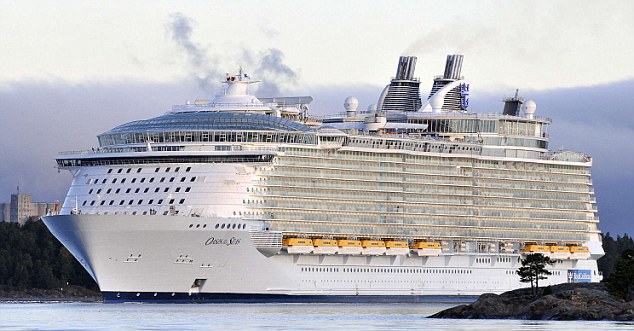
Oasis of the Seas      DailyMail.co.uk  "Inside the world’s biggest and most expensive ever cruise ship, the £810million Oasis of the Seas"

Photo of Royal Caribbean crew member, Mr. Doran McDonald    Jonathon Postal, Miami New Times 

Leukemia blood film    Euthman’s Flickr Photostream

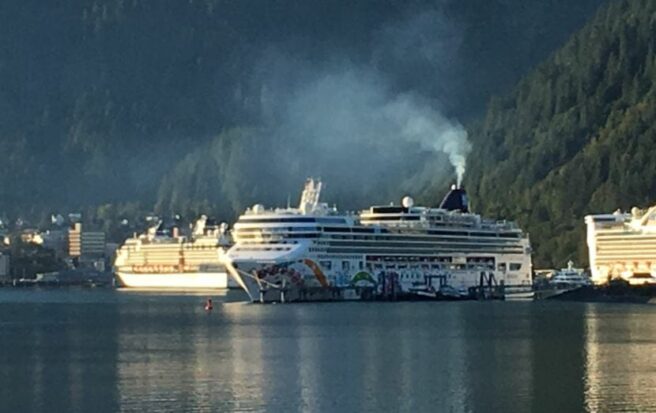
The popular Crew Center blog published an article last week titled Smoke From First Cruise Ship of Alaska Season Alarms Juneau Residents. It mentioned that in mid-April, Norwegian Cruise Line (NCL)’s cruise ship, Norwegian Bliss, sailed into Juneau, becoming the first ship to arrive in the Alaskan capital and officially launching the 2025 cruise season. “While the ship’s return was greeted by many with excitement, its arrival sparked controversy after concerns were raised about the amount of smoke coming from the vessel.”

Crew Center mentioned that a local resident in Alaska, Scott Ranger, posted a letter together with a photo taken by environmental advocate Kate Troll which brought attention to the unusually heavy emissions coming from the Bliss. His letter discussed NCL’s irresponsibility and poor community relations.

“Much of Juneau was excited to welcome the first visitors of the year. A significant part of Juneau was not. I’m pretty much in the first category as I take folks whale watching from the cruise ships. Yesterday, I immediately moved into the second category. The attached photograph shows why. I’m used to the Norwegian Jewel and Sun spewing copious amounts of exhaust, but not the Bliss or the Encore as they are much newer ships. This is not good.

Norwegian doesn’t have the best reputation in Juneau for “community relations” and the Bliss’s entry yesterday was published widely in our town. Folks like me were astonished and maddened that, in an era when cruise ship overload for communities like Juneau is growing rapidly, a major cruise line with a “new” ship would enter with such little regard to the air of our pretty darned pristine place.

If the cruise line continues operating like this, polluting one of the nicest places on the planet, opposition will grow rapidly. We have a second initiative to place legal, hard limits on cruise ships to Juneau. What the Bliss did yesterday will pretty much insure that enough signatures will be gathered to put it on the ballot and that many more people will vote for it than last year’s initiative.

This is an ignominious way to begin the 2025 cruise ship season.”

NCL has not issued a public response.

The spectacle of the NCL ship smoking up the port in Juneau reinvigorated the debate over the future of the oversized cruise tourism in Alaska. Last year, voters in Juneau rejected a ballot initiative to ban cruise ships from docking on Saturdays. Images like the Norwegian Bliss bellowing smoke over the port seemingly has motivated efforts to continue its push for regulations over the cruise industry.

Crew Center also mentioned that in March of this year a plume of smoke from the Norwegian Epic raised alarm while the ship was docked in the British Virgin Islands. The local Environmental Health Division conducted an air quality assessment, ultimately finding the emissions were allegedly within “safe limits” but urging the cruise line to consider switching to low-sulfur fuel while at berth to improve port air quality.

Apologists for the cruise line will undoubtedly argue that the smoke is just “water vapor” from the scrubbers installed on the NCL cruise ship. That what you are seeing is actually not toxic smoke but just some harmless vapor. Cruise ship advocates argue that you “shouldn’t trust your lying eyes,” essentially a variation of the question posed by Groucho Marx (or, more recently, Richard Pryor) – “Who are you going to believe, me or your lying eyes?”

“It’s not pollution, it’s just harmless water vapor” or similar blatherskite is the common refrain whenever NCL, Royal Caribbean or one of the Carnival Corporation brand ships belch emissions over a port due to burning high sulfur fuel.

NCL and other lines have done this before many times and will continue to pollute in the future. Will you be really choose to ignore your own eyes and believe the cruise lines when they tell you everything is fine?

Have a comment of question? Please leave one below or join the discussion on our Facebook page.

Photo credits: Norwegian Bliss – Kate Troll; Norwegian Epic – Jacqueline Archibald; Norwegian Pearl in Juneau / Photo credit Tim Olson / KTOO Public Radio,.

With recent news accounts revealing that Royal Caribbean is housing at sea thousands of COVID-19 infected crew members on four cruise ships, the cruise line is claiming that infected ship employees are largely asymptomatic.

Royal Caribbean International recently told the Washington Post that it is “transferring workers to crew-only ships to wait out their isolation periods.” A cruise line spokesperson claimed that “we have been using out-of-service ships for our crew members who are asymptomatic and mildly symptomatic” in order to “keep our crew and ships as healthy as possible.”

But this seems hardly true. The vast majority of infected crew members on these floating quarantine and so-called hospital ships are clearly symptomatic. Internal charts and documents from one of the ships (sent by  a trusted source) show that symptomatic crew are assigned to the red zone and asymptomatic and close contacts to the yellow zone. Shockingly, well over 80% of infected crew members on the Vision of the Seas, for example, have been assigned to the red zones and the minority to the yellow zones close to infected crew. As you can see from the chart to the right (from the Vision of the Seas)  the red zones comprise the majority of the cabins on decks 2, 3, 4, 7 and 8. The few yellow zones on decks 7 and 8 are designated only for asymptomatic crew members or close contacts.

This chart, and other information, was provided by a concerned crew member who wishes to stay anonymous.

Balconies are only on the exterior cabins on decks 7 and 8 (former guest cabins). All of the ill and symptomatic crew members who are placed in cabins on decks 2, 3, and 4 have no balconies and those on interior cabins on those decks have no windows either.

This means that the already infected crew members who are in either window-less or balcony-less interior decks on 7 and 8 or decks 2, 3 and 4 have no fresh air. The uninfected close contacts are in close proximity to the red zones are share the same recirculated air.

If this concerns you, it should. Don’t forget, COVID-19 is an airborne virus.

It is difficult to imagine a worse place to quarantine and house infected and ill employees than in the bowels of the ship where they are forced to breath recirculated air which is inhaled and exhaled by over 1,500 other infected crew employees.

Royal Caribbean claims that it has retrofitted its old ships like the 23 and 24 year-old Vison and Rhapsody with HEPA filters, but is this really true not only for the guest cabins but the crew quarters as well?

In any event, there is also a distinct concern that such an claustrophobic environment is harmful to the mental health and well-being of the crew.

Personally, I could not possibly stay behind a closed door in a stuffy crew cabin (resembling a large walk-in closet) without a window for even a few hours, much less for ten days of quarantine. How do you say, panic attack?

Read: Diary of a comedian trapped in COVID cruise ship quarantine.

Is this environment really so that the cruise line can “keep our crew and ships as healthy as possible” as the Royal Caribbean spokesperson claims?

Then there is the question of providing medical treatment to the symptomatic employees. On the Vision, there are only two ship doctors and four nurses for over 1,500 crew members, over 80% are symptomatic with fever, headaches, burning throats and fatigue. Some crew, a minority, experience coughs, shortness of breath, and more serious symptoms.

Perhaps the real reason to keep the infected and ill crew on the Vision and other quarantine ships is to avoid the considerable costs of hotels and hospitals in the U.S. There are at least 4,000 Royal Caribbean crew members on the four “plagues ships” currently used by Royal Caribbean (Vision, Rhapsody, Jewel and Serenade). A hotel in Miami and three meals runs around $250 person a day. At 4,000 ill crew members (which the cruise line would not deny or admit to the Post) that’s $1,000,000 a day that the cruise lines figures it can save by keeping the ill crew at sea. This doesn’t include the costs of shoreside medical expenses associated with the excellent U.S. medical system that Royal Caribbean tries to prevent is ship employees from receiving.

The number of infected crew members in the Royal Caribbean fleet is staggering. Royal Caribbean refuses to disclose the official numbers, but there is reliable information that there are a minimum of 1,500 infected ship employees transferred to the Vision and Rhapsody each and over 700 diseased crew members to the Jewel. Add in the several hundred transferred from the Liberty of the Seas to the Serenade late on Wednesday, and the total number of infected crew transferred transferred to these four ship is currently at a minimum of 4,000 and probably a few thousand more.

Thanks to the many crew members who have risked their employment by providing some of the information and documents I have referred to above.

Have a comment or question? Please leave one or join the discussion on our Facebook page

January 14, 2022 Afternoon Update: This morning the Allure OTS met the Vision OTS in Coco Cay, Bahamas and transferred around 165 infected crew members to the Vision and took on 85 crew:

January 15, 2022 Update: The Rhapsody of the Seas, Allure of the Seas and the Harmony of the Seas. rendezvoused in Coco Cay yesterday to try and transfer COCIVD-19 infected crew members later at night.

Last night, the Galveston Daily News reported that the Carnival Vista had a number of positive COVID-19 cases aboard the cruise ship which sailed from Galveston, Texas. However, Carnival Cruise Line refused to state the exact number of infected guests, admitting only that a “small number of people” on board tested positive.

The reporter who wrote the article, Keri Heath, commented that after the outbreak, Carnival made a decision to implement a policy that all guests on the cruise ship are now required to wear masks.

Carnival announced no plans to cancel or alter the cruise.

Around 100 Guests and Crew Members Have Tested Positive for COVID-19 in Last 30 Days

There have been a steady number of cruise ships recently where guests and/or crew members have tested positive for COVID-19. In the five weeks since July 1st, there have been around 100 positive COVID-19 cases on cruise ships:

Royal Caribbean’s Anthem of the Seas (4 crew members), Adventure of the Seas (6 guests), Odyssey of the Seas (13 crew members), Independence of the Seas (10 crew members), Jewel of the Seas (6 crew members); Celebrity Cruises’ Celebrity Millennium (2 guests) and Celebrity Edge (7 guests); Cunard’s Queen Elizabeth (a “small number” of crew members); MSC Grandiosa (2 guests); Phoenix Resien’s M/S Amera (12 crew members); UnCruise Adventures’ Wilderness Explorer (four passengers and three crew members);  (1 guest and 2 crew members); Dream Cruises’ World Dream (1 guest); Viking Cruises’ Viking Sky (1 guest) and Viking Jupiter (1 guest). In addition, at least thirty-five passengers and/or crew members have tested positive on cruise ships designated as either orange or yellow on the CDC’s color tracking chart.

A small couple of positive COVID cases on one ship, a few on another ship, five to eight cases on another and as many as twelve or more cases on some ships – this will be the pattern as long as cruise lines continue to resume operations during a pandemic. The news accounts will mention the positive cases but will invariably stop short of explaining whether the symptomatic guests require medical treatment, or how they respond to medical intervention and/or whether they fully recover, unlike an officer of Carnival Cruise Line who died of COVID last month.

The Miami Herald’s Taylor Dolven recently reported that one in three cruise ships (operating or about to sail into U.S. waters) have passengers and/or crew members aboard who are infected with COVID-19.

The number of positive COVID-19 cases on cruise ships has increased since Ms. Dolven’s tweet (above)

The Centers for Disease Control and Prevention (CDC) currently show that Carnival Cruise Line has seven (7) cruise ships which the CDC is monitoring (orange) or investigating (yellow). The CDC has assigned a yellow code to the Carnival Breeze, Carnival Horizon, Carnival Mardi Gras, Carnival Miracle, and Carnival Vista and is investigating all of these ships for COVID-19. The CDC assigned a orange code to the Carnival Panorama and Carnival Sunshine and is monitoring these ships for COVID.  The CDC assigned yellow codes for other cruise ships owned by Carnival Corporation, including the Coral Princess, Grand Princess and Ruby Princess operated by Princess Cruises and the Nieuw Statendam operated by Holland America Line (HAL).  The Majesty Princess operated by Princess and the Koningsdam operated by HAL both have been designated orange. In total, thirteen (13) cruise ships owned by Carnival Corporation are under monitoring or investigation for COVID-19 by the CDC.

Norwegian Cruise Line Holdings (NCLH)’s Norwegian Encore and the Oceania Regatta are under investigation by the CDC for COVID-19 aboard these two ships.

Royal Caribbean owns ten (10) ships which are under monitoring (orange) or investigation (yellow) by the CDC. There are three Royal Caribbean owned ships operated by Celebrity Cruises under investigation for COVI by the CDC: the Celebrity Edge, Celebrity Equinox and Celebrity Millennium.   The Serenade of the Seas is under investigation for COVID. The CDC is monitoring the Explorer of the Seas, Independence of the Seas, Mariner of the Seas, Odyssey of the Seas  and Ovation of the Seas.

The CDC is Monitoring or Investigating Twenty-Five out of Sixty-Four Cruise Ships In U.S. Waters for COVID-19 

In total, the CDC is monitoring or investigating twenty-five cruise ships in U.S. waters for COVID-19, which is around 40% of the total of sixty-four cruise ship operating or about to sail into U.S. waters.  Of course, this total does not include ships outside of U.S. waters where the CDC does not have jurisdiction.  Aside from occasional coverage by non-U.S. newspapers, there is no centralized data base keeping track of COVID-19 outbreaks on ships sailing from foreign ports in international waters.

On July 28th, before the Carnival Vista sailed on its current cruise, a reporter for the Galveston Daily News, commented that all three cruise ships sailing from Galveston, including the Carnival Vista were either being monitored or investigated by the CDC for COVID-19.

Assuming that those sailing on the Carnival Vista were aware of and reviewed the CDC tracking system, it should have come as no surprise that this particular cruise ship is now the subject of unwanted media attention.

The Carnival Vista – A “Small Number of People” Infected?

It is less than candid for Carnival Cruise Line to state that a “small number of people” are infected on the ship without specifying the actual number of those infected. Another Carnival brand, Cunard, also said that only a “small number” of crew members tested positive for COVID-19 last month on the Queen Elizabeth cruise liner.

Carnival is obviously trying to avoid a situation where the number or positive COVID-19 cases increases, and news accounts subsequently report the updated information and keep the story circulating. This was the situation where the German Cruise Ship M/s Amera initially had an outbreak which was initially reported to involve five cases, then nine cases and eventually twelve cases.

In order for consumers to have a reasonable and accurate sense of which cruise ships have active COVID-19 cases aboard them, families deciding to cruise during a deadly pandemic should, at a minimum, consult with the CDC and see if their ship has been designated either orange or yellow.   But additional information is needed on the CDC’s website, including whether those infected had been vaccinated, whether they were asymptomatic when tested, whether they recovered or ended up hospitalized or died due to their infection.
In my experience, it is too much to ever expect a cruise line to be forthcoming with relevant shipboard disease information that might affect their business interests, especially when some cruise companies are being coy with basic information such as the number of infected guests and crew. My suggestion is to stay current with news coverage from leading newspapers which routinely cover the cruise industry like the Miami Herald, USA Today, or the Washington Post.

Have a comment or question? Please leave one below or join the discussion on our Facebook page.

Image Credit: Top – Carnival VistaGordon Leggett / Wikimedia Commons, CC BY-SA 4.0, commons / wikimedia;  bottom – Carnival Vista stern – ABC-13 Eyewitness News Carnival managing ‘small number’ of positive COVID cases on board cruise ship.

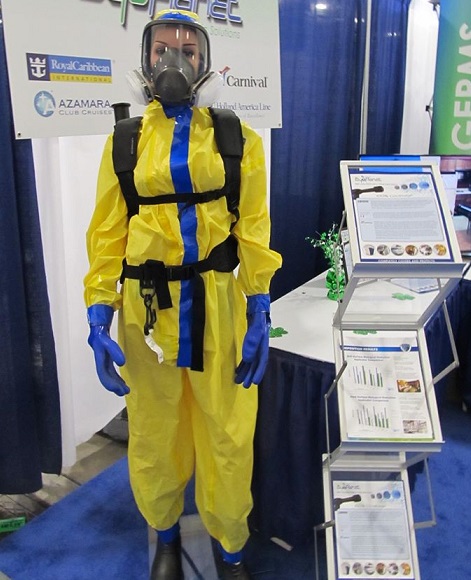
Several years ago, I attended the annual Sea Trade Conference (now called the Cruise Shipping Miami) where companies which cater to the cruise industry promote their services and products. One company was advertising disinfectant spraying services for the cruise lines in order to eradicate contagious viruses. The company displayed a mannequin wearing a full body hazmat suit.

The Cruise Industry Has A History of Providing Inadequate Equipment and Training to its Crew Members to Deal With Viral Outbreaks

I have never seen or heard of a crew member wearing such a suit in combating the hundreds of virus outbreaks which have plagued cruise ships over the last twenty-five years. MRSA, Norovirus, E. coli, H1N1, Salmonella enterica, Staphylococcus aureus, Legionella pneumophilia, Hepatitis B&C, Aspergillus niger and so on.

So I took a photo of the suit (top) and added it to my collection of photographs of Cruise Shipping Miami 2015, thinking this is what cruise lines should be using when dealing with a virus outbreak.

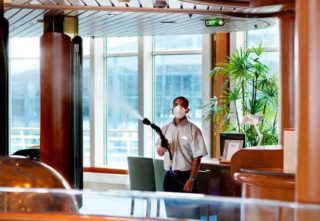
A number of people subsequently sent me photos (below right) and videos of crew members spraying after norovirus outbreaks. They are usually wearing inadequate personal protection equipment (“PPE”). Gloves maybe, but inappropriate masks, no face-guards, and no bodysuits, of course. “That’s too expensive,” cruise lines undoubtedly concluded, before the coronavirus outbreak occurred. The sad reality is that no crew member seems to have ever worn such an outfit in dealing with the run-of-the-mill norovirus outbreak.  Fast forward to the current cruise coronavirus outbreak. No cruise line has staffed its ships or equipped its crew members with such equipment to deal with outbreaks.

As the New York Times’ article titled Failures on the Diamond Princess Shadow Another Cruise Ship Outbreak has made clear, the crew members on the Diamond Princess, who were forced to interact with ill guests on the Diamond Princess were literally ill-prepared to deal with the coronavirus.

New Cruise Coronavirus Outbreaks

Coronavirus outbreaks on cruise ships, of course, have continued to occur even after the cruise industry announced that it has temporarily suspended  operations.

Fred Olsen Cruise Lines’ Braemar is  25 miles off the Bahamas after twenty guests and an equal number of  crew members, including a doctor, are in isolation after they displayed influenza-like symptoms. The latest news is that there are at least five confirmed coronavirus cases aboard the ship.

Passengers who recently traveled aboard the Carnival Valor cruise ship are being urged to contact their local health department after a disembarked passenger tested positive for COVID-19. According to local news reports, the Carnival Valor cruise left from New Orleans on Feb. 29th to Cozumel and Yucatan, and returned to New Orleans on March 5th. The patient with the confirmed case returned home to Ohio on March 6th and started having symptoms the next day. He was tested for COVID-19 on March 12th, and officials received the positive test result on Friday night. (If anyone from the Central Ohio area was on the Carnival cruise ship the Valor from Feb. 29-March 5 they are asked to call 614-645-1519). It appears that Carnival is not concerned with checking whether other people, like taxi and uber drivers, airplane passengers and other cruise guests, have been infected with coronavirus:

https://twitter.com/maganslife/status/1239188681858187264?ref_src=twsrc%5Etfw%7Ctwcamp%5Etweetembed%7Ctwterm%5E1239188681858187264&ref_url=https%3A%2F%2Fwww.cruiselawnews.com%2Fwp-admin%2Fpost.php%3Fpost%3D10923%26action%3Dedit

When Carnival finally suspended its operations, it claimed that it had never experienced a crew member or guest with coronavirus. It can’t claim that anymore.

There are also several new coronavirus outbreaks on Carnival-owned cruise ships operated by its subsidiary, Costa.

The Carnival-owned Costa Luminosa, Costa Favolosa, Costa Diadema and Costa  Magica experienced coronavirus outbreaks aboard both ships, according to crew members who contacted our office.

Ironically, a passenger from a cruise ship in the Cayman Islands with coronavirus became the first such patient in that island with the disease. Carnival had earlier refused to call on the Cayman Islands because it had refused to cowtow to Carnival’s attempt to avoid its strict health protocols.  Later the Costa Luminosa disembarked two ill passengers in Puerto Rico.

Puerto Rico  barred a Celebrity Summit cruise ship from the port of San Juan from disembarking because a Canadian passenger, already back home in his country, tested positive for COVID-19 and died, according to the Miami Herald.

A Canadian passenger tested positive for coronavirus over the weekend on the Silver Shadow, which is docked off the port of Recife in Brazil, according to a passenger on the ship who contacted me. The test came back positive for COVID-19. The ship is under quarantine. The passengers state that not all of the crew members are wearing PPE.

The Silver Explorer docked in Castro, Chile, this weekend after an 83-year-old British passengers was diagnosed with COVID-19. The ship’s owner, Royal Caribbean, confirmed the coronavirus case on Sunday.

The Norwegian Jewel, which apparently has no coronavirus cases at this time, is searching for a port after being denied permission to dock in ports in French Polynesia, Fiji, New Zealand and Australia, and is now piloting to American Samoa to refuel.  NCL says that it is working to find an alternative port and is communicating with guests regularly, which passengers dispute.

Meanwhile, NCL has been accused of fraudulent conduct in selling cruises and misrepresenting the seriousness of the pandemic. A series of emails sent to the Miami New Times, and later published by the Washington Post, reveal that NCL gave false information about coronavirus to the public to lure passengers aboard its ships. An employee informed the New Times newspaper that NCL managers pressured sales staff to lie to customers about COVID-19 to protect the company’s cruise sales. One such talking point included the false promise about “warm air killing the virus.”

Miami’s Daily Business Review just reported that a class action lawsuit was filed last Friday in U.S. District Court for the Southern District of Florida, alleging that investors took financial hits due to false statements to passengers such as saying that coronavirus wouldn’t affect their cruises.

Crew Members Express Fear of Being Sickened or Abandoned

Crew members on the Costa Diadema indicate that the ship is sailing back to Savona from Dubai without passengers aboard. They are expressing alarm that Costa is taking the ship to Italy due to the high rate of infection in Italy. Crew members on this ship who are at the end of their contracts were not permitted to disembark while the ship was in Dubai. Meanwhile, there are crew members who have tested positive with coronavirus on the ship.

Over one thousand crew members on the contaminated Grand Princess still have not been tested even though 19 of their colleagues on that ship are ill with COVID-19. There appears to be no plans by any cruise lines, even with ships which call on U.S. ports, to provide medical treatment ashore for their employees in order to comply with their maritime and legal obligations

Crew members are uniformly expressing concern that their employers will refuse to pay them anything once they leave their ships and are returned home.  Several MSC crew members explained that they are at the beginning of their contracts and the cruise line will not compensate them at all once they are sent home.  Crew members from the Philippines have written an open letter to the president of their country asking for their mortgages, loans and other financial obligations to be suspended so they can try to survive financially.

https://www.facebook.com/RinellBandaBSCS/posts/1833436860120856?__xts__%5B0%5D=68.ARChFUhTzSIKc36oAhQumper7n8kZtcNPE1jvO9QHKqHTyTxL3bn56Woxgy7csyva59ud3fP3sRsfIWphxh3lXh626xILDY4oR1AEauPmzAQOlQ7ElrP623b7oXdpS3mXLHNfRqnmKmMTEhYnnHTEv4O_Q0JIeo8mWzQvYZgQpncnlGxbmonl3iUPyDjP3gRjK0lLff1Bc1peqoNKg3AkTp9X_5La2Q4Jz1qDPfhz2gX-laBfr4QuHabMc1LoKXzl8h2eEIpo1RTg8l5tLQX6kaQp259pkdtybSe6HbwKesqzJBCMtHNZv3p63UOSZxurZakleMCDp35735AhWbK-w&__tn__=-R

In an article titled Cancellations Due to Coronavirus Drive Fear Among Cruise Workers About Being Sent Home Without Pay, the Washington Post explains that many crew members worry not about catching the virus, but about their contracts being cut short and being sent home, without pay.

Ironically, the Trump administration is indicating that the foreign-flagged billion dollar cruise industry will likely be provided with U.S. financial aide, with no mention of the financial burden that crew members are now facing. Cruise lines already enjoy tax benefits and are not required to comply with U.S. wage and labor laws. The industry should not receive a handout unless financial consideration for the crew, who are the backbone of the industry, be approved. The net worth of Carnival Corporation’s Chairman Micky Arison is over $8,000,000,000. NCL’s CEO Frank Del Rio earned around $32,000,000 one year alone a couple of years ago. Bailout funds should not find their way into the pockets of these “fat cat” cruise executives.

Have a comment? Please leave one below or join the conversation on our Facebook page.

Yesterday, St. Lucia quarantined a cruise ship  after a case of measles was confirmed on board, according to NBC News and the Washington Post. The government of this Caribbean island stated that the ship was quarantined at the port with around 300 passengers and crew members not permitted to disembark. Measles of course is highly infectious.
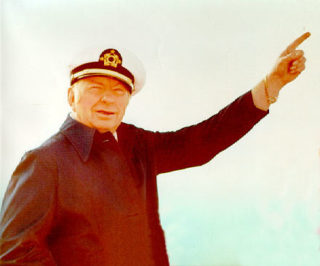
Scientology Cruise Ship?

A Coast Guard official in the St. Lucian Coast Guard reportedly told NBC News that the cruise ship involved is the M/V Freewinds, which is owned and operated by the Church of Scientology.

But instead of publishing photos of the relatively small 40 year old Scientology ship (440 foot length, approximately 10,000 ton displacement), a number of major news sources, like BBC News, ABC News, the Independent and others, are publishing photos of large (1,000 length, over 100.000 tons) cruise ships operated by major cruise lines like Costa Cruises, Norwegian Cruise Line (NCL) and Princess Cruises.

Captain L. Ron Hubbard?

We previously wrote about the Freewinds in 2011 when we discussed a weird and disturbing report that the Scientology organization allegedly held a young woman against her will on its cruise ship. It seems that the Scientology cult uses the cruise ship to teach specialized services in “advanced spiritual concepts” based on lectures that its leader L. Ron Hubbard gave in the 1960s.  Hubbard thought that the path to higher spirituality could be found in settings like cruise ships sailing to tranquil locations.  Hubbard was often photographed wearing a captain’s hat.
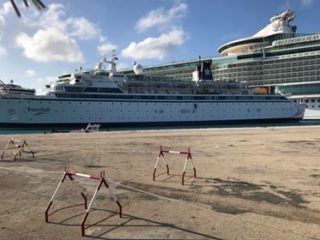
In 2008 asbestos was located on the ship and the cruise ship was declared a health hazard.  It was dubbed the Death Ship.

The Freewinds also came under criticism for discharging waste and polluting the waters of southern Caribbean islands.

Cruise Ship Measles Cases

This is not the first time that a case of measles was reported on a cruise ship.

In 2018,  a passenger on a NCL cruise ship (the Norwegian Jewel) visiting Alaska had the measles, according to health officials at the Alaska Department of Health and Social Services, prompting concerns that other cruise passengers as well as air travelers may spread the virus.

In 2014, another NCL cruise ship, the Norwegian Pearl, had a confirmed case of measles by a crew member while the ship was cruising in Alaska.

2014 also saw the Italian newspaper Il Messaggero report a measles outbreak which occurred on the Costa Pacifica cruise ship.

A measles outbreak is very serious. There is a particular danger to women of childbearing age with measles. U.S. based cruise lines vaccinate for measles because the virus is so virulent.

Have a thought? Please leave a comment below or join the discussion on our Facebook page.

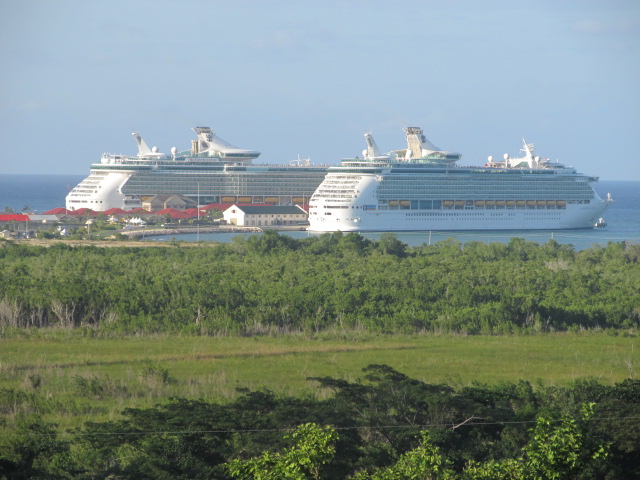
Photo credits: Freewinds – Top – Roger Wollstadt – Flickr: Aruba – Freewinds, CC BY-SA 2.0, commons / wikimedia; Freewinds – Bottom – January 2019 in Aruba, moored next to Royal Caribbean’s Freedom of the Seas – photo credit – Holly via Facebook.


This past week, I received information from a reader of Cruise Law News who lives in Bergen Norway. He explained that the Norwegian Maritime Authority (NMA) is using drones equipped with measuring instruments to test sulphur levels in ship emissions.

There is an article in the Maritime Authority’s latest publication, Navigare, regarding this issue. Translated, the article states “. . . a drone with measuring instruments was operated from the bridge of the Coast Guard vessel KV Tor. In the course of a week or so at the beginning of June, the drone was manoeuvred into exhaust discharge from several ships in the area and details of sulphur content immediately appeared on a data screen on board the Coast Guard vessel. The highest concentration was measured on the Portuguese flagged cruise ship Astoria as it was entering the harbour of Bergen.”

The NMA states that it is using the drone technology to hunt “sulphur sinners.”

The drones are owned by the Norwegian Coast Guard whereas the detectors are owned by the NMA.

An article in Bunkerspot which was published today states that the Norwegian Maritime Authority has carried out 205 inspections to check sulphur content in emissions from ships. Five violations were uncovered the ships received penalties of between $30,500 and $73,000.

As the IMO .5% sulphur limitation comes into effect in 2020, there will be an increasing number of cruise ships which violate the international restrictions on the amount of sulphur in fuel as well as the emission standards in states such as Alaska.

Today, I received a photograph (at top of this article) taken by a crew member which shows the exhaust plumes from the Norwegian Jewel and the Radiance of the Seas (as well as the Explorer of the Seas, obscured) in Skagway, Alaska. These cruise ships utilize scrubbers, rather than switching to cleaner but more expensive low-sulphur fuel. As you can see, the steam ends and the blue shaded exhaust emissions, which contain solid particulate matter, is evident. Alaska uses a subjective opaqueness test which is subject to a wide variety of non-objective interpretations. Cruise ship supporters often falsely claim that the cruise ship emissions are just steam from the ship’s stacks as opposed to harmful non-combustible particulate matter. Drones with sulphur detection systems will go a long way to objectively collect data in order to hold cruise ships accountable for violating air pollution laws and regulations.

The Alaska Department of Environmental Conservation (DEC) issued air quality violations to eight cruise ships and water quality violations to nine cruise ships last week, according to the Juneau Empire.

In an article by Kevin Gullufsen, the newspaper reported that four Holland America Line (HAL) cruise ships, two Princess Cruises ships, and one cruise ship operated by Norwegian Cruise Line (NCL) and one ship operated by Royal Caribbean violated Alaska’s air quality standards throughout the cruise season’s summer months (June-August).

Alaska’s DEC cited HAL’s Eurodam, Westerdam, Amsterdam, and Nieuw Amsterdam; Princess’ Emerald Princess and Golden Princess; NCL’s Norwegian Jewel; and Royal Caribbean’s Radiance of the Seas (which was cited twice).

Last year, the DEC determined that NCL’s Norwegian Jewel and HAL’s Amsterdam violated Alaska’s air standards.

The violations reportedly could result in fines as high as $46,192 per cruise ship.

The manager of Alaska’s cruise ship emissions monitoring program told the Juneau Empire that: “opacity is an indicator for overall air quality. So there are things that could be in the emissions. Things like nitrogen oxides or particulates. Things that can be breathed in and can potentially cause some health effects.”

Just last week in another article by Kevin Gullufsen, the Juneau Empire reported that “exhaust emissions poured from the Norwegian Pearl’s exhaust stack” as the NCL cruise ship was docking in Alaksa. The DEC has not yet announced whether the Norwegian Pearl violated Alaska’s air quality standards.

A few days later, a Canadian resident filmed the same NCL cruise ship spewing emissions in Victoria and posted the film on Twitter, which you can see below.

The DEC also found that nine cruise ships violated Alaska’s water quality standards this summer, according to the Juneau Empire.

Five Princess cruise ships violated water quality standards, including the Emerald Princess, Island Princess, Golden Princess, Ruby Princess and Star Princess.  The Star Princess and the Emerald Princess violated the water standards twice.

The DEC also issued wastewater discharge violations to HAL’s Eurodam, Noordam, and Voledam, as well as Seabourn Cruise Line’s Sojourn.

A month ago, we reported that Princess Cruises’ Star Princess recently discharged sludge from its exhaust system scrubbers in the port of Ketchikan, according to the city of Ketchikan. The discharge was originally reported by KRBD Community Radio. KRBD reported the Star Princess’ discharge and a similar discharge from the Golden Princess while the ship was in Ketchikan.

As shown by photographs (above and on our Facebook page, courtesy of the city of Ketchikan), the sludge polluted the waters of Ketchikan and fouled the port facilities where the Princess cruise ship were berthed. The DEC has not yet announced that these particular discharges violated Alaska’s water standards.

Princess denied the reports, claiming that “our experts believe what was viewed and photographed is most likely sea foam discolored by natural microorganisms such as algae in the seawater, which is commonly experienced in northern climates in the summer season.”

Alaska cited two cruise ships operated by Princess Cruises for violating both air and water standards – the Emerald Princess and Golden Princess.

The air violations by HAL, Princess and Royal Caribbean and the water violations by HAL and Princess all involved pollution by cruise lines which have pleaded guilty to environmental violations and lying to the U.S Coast Guard. Princess was the latest cruise line to have pleaded guilty to such crimes and lying to federal agencies, resulting in a fine of $40,000,000.  Federal prosecutors found that the Star Princess and the Golden Princess were in the middle of Princess’ widespread, ongoing schemes to pollute and lie about it.

Princess appears to be in direct violation of the guilty plea agreement (where it promised not to commit further violations of international, federal, state, or local environmental laws) which it entered into with the federal government in December of 2016. Whether the federal government does anything about Princess’ continuing pattern of pollution is another matter.

Have a comment? Please leave one below or join the discussion on our Facebook page.

September 13, 2018 Update: Alaska’s Department of Environmental Conservation stated today that the DEC issued wastewater citations to HAL for “unauthorized discharge of untreated graywater” from the Noordam. It cited Princess Cruises for “unauthorized discharge of treated graywater” from the Star  Princess.  The DEC’s notices of violations issued for water standards were all related to unauthorized untreated graywater or treated mixed graywater and sewage, in violations of Alaska’s wastewater discharge permit. These are not for scrubber washwater discharges.

Photo credits: Top – Norwegian Pearl in Juneau / Photo credit Tim Olson / KTOO Public Radio; middle – city of Ketchikan via KRBD Community Radio.

In Falmouth, Jamaica, the Port Authority of Jamaica is continuing to pursue dredging projects in order to permit the gigantic "mega liners," including Royal Caribbean’s Oasis Class (sometimes called "Genesis-class") cruise ships to squeeze into the port, which was rebuilt in 2011. During the construction of the two new two piers, the port was originally dredged.    

Jamaica has a goal of boosting the numbers of cruise visitors, seemingly irrespective of the damage which dredging will cause to the environment around the port. At the urging of Miami-based cruise lines, the government of Jamaica intends to dredge the southern berth of the port at Falmouth this year. This will cause significant further destruction of the reefs around the port in order to allow two Oasis-class vessels to dock at the same time.

This is part of the plan recently touted by the Jamaican Prime Minister Andrew Holness which Falmouth Jamaica Portfeatures further dredging the port of Falmouth, referred to alternatively in the Jamaican Gleaner as the "jewel of the Caribbean" or "the region’s number one destination" for cruise shipping.

Prime Minister Holness stated to the Jamiacan newspaper that the Falmouth pier ‘"was built in anticipation for not only the growing demands of the cruise industry, but also the fact that cruise ships were "getting bigger by the day." He was quoted as saying "it wasn’t that long ago when we had ships with a carrying capacity of say 2,000 being touted as the largest cruise ships in the world. Since then, we have seen a number of vessels earning that title. We have had Freedom of the Seas, Oasis of the Seas, Allure of the Seas and now, we have Harmony of the Seas, with its 2,747 staterooms, and 8,550 guests and staff on 16 decks."

The Prime Minister noted that it was an "excellent idea to have constructed this port. We can now host the mega liners and all the Oasis Class vessels."

Six years ago, in my article titled Royal Caribbean’s New Port in Falmouth, Jamaica – At What Cost to the Environment?, I cited the article of Can the Cruise Industry Clean Up Its Act? by Michael Behar, who wrote that in Falmouth, Royal Caribbean oversaw the smashing of "a quarter-mile-wide opening in an offshore barrier reef. They dredged coral, both living and dead, as well as the rock substrate, and trucked it inland to a two-square-mile dump site — a clear-cut area on the outskirts of town that was once a thriving red mangrove swamp. Now all that’s left is 35 million cubic feet of pulverized coral and rubble. When I visit the site with Roland Haye, a Jamaican environmental activist, he tells me, ‘As a boy, I used to play Tarzan here and see crocodile. It was a winter home for great heron and swan.’ He points out broken conch shells, dismembered starfish, bits of sea sponge, and severed lobes of brain coral." 

In that article, I wrote that the removal of the natural reef exposes the shore to pounding of the waves from the adjacent bay.  "When I visited (back in 2012) , I observed that the road . . .  to Falmouth, previously protected from the pounding of the by the reef, was literally covered with water from the encroaching waves. The road was already eroding . . ."

Yesterday, a friend of mine in Montego Bay filmed a short video from his cell phone as he drove into Falmouth. The video shows the bay’s waters from the now destroyed reef system lapping over the deteriorating roadway into the port of Falmouth.   

Have a comment? Please leave a comment below or join the discussion on our Facebook page.  

Photo credit: Falmouth Port (above) – Jim Walker

https://youtube.com/watch?v=a7gOaj5Sb6E%3Frel%3D0

The United Stated State Department issued a new crime warning for the Bahamas. You can read the new warning issued on January 10, 2018 here.

The crime warning states, in part:

Exercise increased caution in The Bahamas due to crime.

Violent crime, such as burglaries, armed robberies, and sexual assault is common, even during daylight hours and in tourist areas. U.S. government personnel are not permitted to visit the Sand Trap area in Nassau due to crime. Jet-ski operators are known to commit sexual assaults Nassau Port Cruiseagainst tourists, including minors. As a result, U.S. government personnel are not permitted to use jet-ski rentals on New Providence and Paradise Islands.

The warning refers to the U.S. State Department’s Overseas Security Advisory Council (OSAC) whose 2017 Report for the Bahamas characterizes crime in that country as "critical.

The OSAC report states that the majority of reported violent crimes were against local Bahamians and mostly occurred in areas of saturated criminality not typically visited by tourists; however, New Providence (Nassau), where around 250,000 Bahamians live, has witnessed "violent crimes in locations more commonly frequented by U.S. citizen tourists. In some instances, these incidents resulted in fatalities. Criminality and violent crime has increased on Grand Bahama island, notably crimes involving the use of machetes."

"Many criminals carry firearms, machetes, or knives, and these weapons are commonly brandished . . . there were reports of firearms used in the commission of armed robberies, where the assailant assaulted the victim after the victim resisted. Many of these armed robberies were snatch-and-grabs involving purses, jewelry, cell phones, and cash. Should you be confronted by someone demanding money/valuables, you should comply with their demands and make the encounter as brief as possible. If confronted, try to remain calm, clearly display your hands and do not make any sudden moves that could be interpreted as resistance.

Armed robberies, property crimes, purse snatchings, theft, fraud, and sexual assaults remain the most common crimes perpetrated against tourists."

The OSAC report further documents that "in 2016, numerous incidents were reported that either involved tourists or occurred in well-known tourist locations. Crimes occurred near popular tourist areas adjacent to the cruise ship port (Prince George Wharf) and the Cable Beach resort areas as well as the popular downtown area. Several armed robberies of U.S. citizens have occurred in daylight hours in heavily frequented tourist areas."

We have reported on over a dozen U.S. warnings about the high level of crime in the Bahamas, primarily in the capital city of Nassau. 

In 2014, we selected Nassau as the most dangerous port of call in our list of the Top 10 Most Dangerous Cruise Destinations in the World, and later stated that Nassau was "one gunshot away" from the cruise lines exiting that port. 

As we wrote then, we have been warning about crime in Nassau ever since we started this blog in September 2009. In October 2009, two "vicious robbers" robbed a group of 11 terrified cruise passengers from a Royal Caribbean ship by gunpoint in Nassau. In November 2009, 18 cruise passengers were robbed during excursions from Royal Caribbean and Disney cruise ships. 

The Nassau Guardian published an article about the new crime warning. 

In response to the warning which mentions the fish fry businesses at Arawak Cay in Nassau, Bahamian Tourism Minister Dionisio D’Aguilar criticized the crime advisory to the Tribune newspaper in Nassau, suggesting that Nassau was safe compared to major American cities like "Chicago or New York.”

This is a common although misleading argument.  The per capita murder rate in the country of the Bahamas is higher than the per capita rate in Chicago and many, many times higher than the per capita rate in New York City. In the U.S., the per capita murder rate is a little over 4 per 100,000; in the Bahamas, the rate is around 40 per 100,000

Have a comment? Please leave one below or join the discussion on our Facebook page. 

Photo credit: TampAGS, for AGS Media – Own work, CC BY-SA 3.0, commons / wikimedia.

BahamasThe U.S. Overseas Security Advisory Council (OSAC) recently published its 2017 Crime & Safety Report regarding the Bahamas.

The council, which was established under authority of the U.S. Secretary of State, reached the following findings and conclusions:

Findings:

  • The Bahamas is a major Caribbean tourist destination with major cruise ship ports of calls in Nassau and Freeport. 
  • Over six million U.S. citizens visit the Bahamas each year.
  • Approximately 80% of tourists to the Bahamas are U.S. citizens.
  • The Bahamas consists of more than 700 islands and cays.
  • The Bahamas has a population of approximately 370,000.
  • 70% of Bahamians (around 260,000) reside on the island of New Providence, where Nassau is situated.
  • Another 15% (around 60,000) live on Grand Bahama, where Freeport is located.
  • The rest of the population is dispersed over several dozen outer islands (commonly referred to as the “Family Islands”).

Conclusions – Crime Threats:

  • Crime in Nassau is critical.
  • Violent crime reportedly dropped from 2015 to 2016 by double digit percentages in every category, although some observers have questioned the legitimacy of this claim.
  • Murders were down 24% from a record high in 2015 (111 in 2016 vs. 146 in 2015).
  • Despite the publicized numbers, crime continues to represent the primary security threat in the Bahamas.
  • The preponderance of reported violent crimes were perpetrated against local Bahamians and mostly occurred in areas of saturated criminality not typically visited by tourists.
  • However, New Providence has witnessed violent crimes in locations more commonly frequented by U.S. citizen tourists. In some instances, these incidents resulted in fatalities.
  • Criminality and violent crime has increased on Grand Bahama island, notably crimes involving the use of machetes.
  • Many criminals carry firearms, machetes, or knives, and these weapons are commonly brandished.
  • There were reports of firearms used in the commission of armed robberies, where the assailant assaulted the victim after the victim resisted.
  • Many armed robberies involved snatch-and-grabs involving purses, jewelry, cell phones, and cash.
  • Armed robberies, property crimes, purse snatchings, theft, fraud, and sexual assaults remain the most common crimes perpetrated against tourists.
  • In 2016, numerous incidents were reported that either involved tourists or occurred in well-known tourist locations.
  • Crimes occurred near popular tourist areas adjacent to the cruise ship port (Prince George Wharf) and the Cable Beach resort areas as well as the popular downtown area.
  • Several armed robberies of U.S. citizens have occurred in daylight hours in heavily frequented tourist areas.
  • The water sports rental industry is only loosely regulated, and in 2015, there were reported sexual assaults of U.S. citizens, including minors, by jet-ski operators.
  • The majority of these sexual assaults were reported to have occurred on relatively “safe” beaches within the confines of Paradise Island, which is heavily frequented by tourists . . .

We recommend to anyone traveling to the Bahamas (particularly Nassau) to also read the news accounts and editorials in the local newspapers in the Bahamas, the Tribune and the Nassau Guardian

Have a thought? Please leave a comment below or join the discussion on our Facebook page.

Photo credit: Bahamas government – Public Domain, commons / wikimedia.

Royal Caribbean Cruise DrugsWFTV reports this evening that two Royal Caribbean crew members were arrested for smuggling cocaine aboard the Freedom of the Seas into Port Canaveral.

One of the Royal Caribbean crew members identified is Junior Ellision, age 31. The news station said that when "Ellision left the ship, he took a shuttle to a Merritt Island Walmart. Authorities said Ellision would pick up sandals filled with cocaine in St. Maarten and would wear them off the ship. Ellision would then go to the Walmart, buy a pair of sandals, and then put the cocaine filled sandals in the Walmart bag to deliver to someone else."

The other Royal Caribbean crew member, also from the Freedom of the Seas, is identified as Sheldon Grant. We do not know the job positions or the home countries of these two ship employees.

WFTV reports that the two crew members admitted that "they had made multiple deliveries and that someone paid them $1,250 each time" that they delivered the drugs. 

Drugs busts of Royal Caribbean and Celebrity passengers and crew members are not uncommon:

Allure of the SeasEmpress, Enchantment of the Seas, Explorer of the Seas, Grandeur of the Seas, HorizonJewell, Liberty of the SeasSplendor of the Seas, and Summit.  

Video and image credit: WFTV

April 27 2016 Update:  Crew members have told us that the two crew members on the Freedom of the Seas are from Jamaica and worked as galley utility. 


http://up.anv.bz/latest/anvload.html?key=eyJtIjoiYW52IiwicCI6ImRlZmF1bHQiLCJ2IjoiMzYwNDgyNiIsInBsdWdpbnMiOnsiZGZwIjp7ImNsaWVudFNpZGUiOnsiYWRUYWdVcmwiOiJodHRwczovL3B1YmFkcy5nLmRvdWJsZWNsaWNrLm5ldC9nYW1wYWQvYWRzP3N6PTQwMHgzMDAmaXU9LzEyNTIzMjkzL09ybGFuZG9fVFYvd2Z0dl93ZWJfZGVmYXVsdC9uZXdzL2xvY2FsJmltcGw9cyZnZGZwX3JlcT0xJmVudj12cCZvdXRwdXQ9dmFzdCZ1bnZpZXdlZF9wb3NpdGlvbl9zdGFydD0xJnVybD1odHRwOi8vd3d3LndmdHYuY29tL25ld3MvbG9jYWwvcm95YWwtY2FyaWJiZWFuLWNyZXctbWVtYmVycy1hY2N1c2VkLW9mLXNtdWdnbGluZy1jb2NhaW5lLWluLXNhbmRhbHMvMjQzNzEwMjAyJmRlc2NyaXB0aW9uX3VybD1odHRwOi8vd3d3LndmdHYuY29tL25ld3MvbG9jYWwvcm95YWwtY2FyaWJiZWFuLWNyZXctbWVtYmVycy1hY2N1c2VkLW9mLXNtdWdnbGluZy1jb2NhaW5lLWluLXNhbmRhbHMvMjQzNzEwMjAyJmNvcnJlbGF0b3I9V0ZUViJ9fSwiY29tc2NvcmUiOnsiY2xpZW50SWQiOiI2MDM1OTQ0In0sImhlYXJ0YmVhdEJldGEiOnsidmVyc2lvbiI6IjEuNSIsIm1hcmtldGluZ0Nsb3VkSWQiOiIxNDYyMzRCODUyNzgzNUUxMEE0OTBENDRAQWRvYmVPcmciLCJjdXN0b21UcmFja2luZ1NlcnZlciI6ImNveG5ldC4xMTIuMm83Lm5ldCIsInRyYWNraW5nU2VydmVyIjoiY294bmV0LmhiLm9tdHJkYy5uZXQiLCJqb2JJZCI6ImoyIiwiYWNjb3VudCI6ImNveHdmdHYsY294Z2xvYmFsIiwicHVibGlzaGVySWQiOiJjb3huZXQifSwicmVhbFRpbWVBbmFseXRpY3MiOnRydWV9LCJhbnZhY2siOiJhbnZhdG9fY294X2FwcF93ZWJfcHJvZF9jZTQ1Y2RhMjM3OTY5ZjkzZTcxMzBmNTBlZThiYjYyODBjMTQ4NGFiIn0


The Travel Channel just posted a cruise safety video as part of it’s Travel 911 series (be prepared before things go wrong on a cruise ship).

Its a very friendly sounding video that says that there’s nothing better than a cruise, but bad things can happen on cruise ships.  

Here are some tips:

  • Bring anti-bacterial wipes and avoid public bathrooms. And check out which ships have high scores on the Centers for Disease Control (CDC) website.
  • Attend muster station drills. They are mandatory before the ship sails and can be a life-saver.
  • Limit your drinks. The number one reported crime during cruises is sexual assault. The victims are usually intoxicated.
  • Don’t flaunt your jewelry, handbags, or money. Yes, there are thefts during cruises.
  • Be extra-safe during shore excursions. Keep your cash and jewelry in the cabin safe and wear a traveler’s pouch.   

Have a thought? Please leave a comment below or join the discussion on our Facebook page. 


https://screen.yahoo.com/cruise-safety-141537603.html?format=embed