



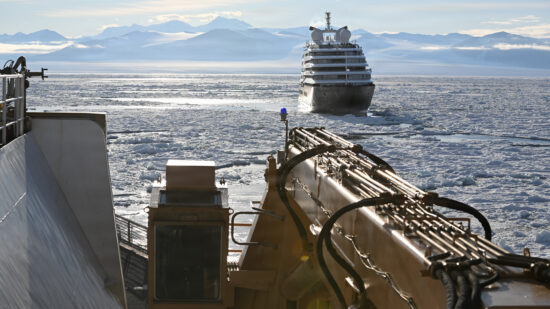
A luxury cruise ship became trapped in thick Arctic ice in the Ross Sea on January 17, 2026. The cruise ship, Scenic Eclipse II, required assistance from the USCGC Polar Star, the U.S. Coast Guard’s only heavy icebreaker, to break it free from the ice.
According to the U.S. Coast Guard, the Scenic Eclipse II contacted the Polar Star at approximately 11 p.m., local time, after getting stuck in the ice. The Polar Star circled the stranded cruise ship twice, breaking the ice around it, before escorting it four nautical miles to open water. The Polar Star was in Antarctica supporting U.S. scientific and logistical operations as part of Operation Deep Freeze 2026.
Footage recorded by the U.S. Coast Guard can be seen below.
The rescue operation occurred on the Polar Star’s 50th birthday as the ship was commissioned on January 17, 1976. The ship is described by the U.S. Coast Guard as “the world’s most capable non-nuclear icebreaker.”
No injuries have been reported on the Scenic Eclipse II and guests were reportedly served champagne while they watched the rescue operation unfold.
Scenic Luxury Cruises and Tours, the cruise line that operates the Scenic Eclipse II, said in a statement, “On the evening of 16 January 2026 Scenic Eclipse II was in the Ross Sea near McMurdo Sound operating helicopter flights to the Dry Valleys. Due to changes in the pack ice during the day, progress was slower than planned to depart the area and the Captain requested assistance from nearby vessel USCG Polar Star to clear the way together and avoid a longer sailing period at reduced speed.”
The cruise line downplayed the incident and the need for rescue services, “While Scenic Eclipse II was never in need of rescue services, the co-ordination between both vessels ensured we could navigate the changing pack ice safely and efficiently.”
The Australian-based Scenic Luxury Cruises and Tours does not have to pay the Coast Guard or any other U.S. federal agency for the rescue operation. As we have previously written, cruise lines have no obligation to pay for rescue operations regardless if they were at fault.
Have a comment or question? Please leave one below or join the discussion on our Facebook page.