


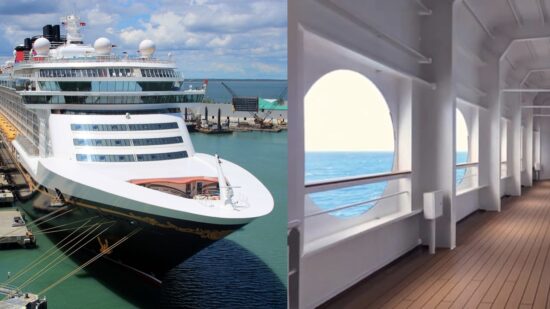
This past June, a 5-year-old girl fell overboard from the Disney Dream while the ship was sailing to Fort Lauderdale, Florida, from the Bahamas. The girl’s mother was taking photos of her on the ship’s railing when the child lost her balance and fell backward.
The child fell through an open porthole into the water. The girl’s father heroically jumped into the water to save his daughter. He treaded water for 20 minutes with her before being rescued by crew members.

The mother assumed that the porthole was covered by plexiglass which it was not. There is no plexiglass over any part of the porthole or the upper and lower railings on the Disney Dream. Nor was there any sign warning not to climb up on the railing. This is to be contrasted with portholes on the Disney Fantasy, a sister ship to the Disney Dream, where the railings are affixed with plexiglass (circled in red) including a covered step at the bottom of the porthole. The portholes on the Disney Fantasy also have warning signs.

The incident gained renewed media interest after reports emerged that prosecutors decided not to charge the mother with child neglect.
A memorandum by Florida’s state attorney read that the woman’s “conduct is arguably negligent and irresponsible, it does not rise to the egregious level of conduct necessary to establish criminal culpable negligence,” as reported by The New York Times.
What has been overlooked in this story is that the man overboard system on the Disney ship may have played a key role in saving the child and father’s lives. The father triggered the ship’s man overboard system after he jumped in at around 11:30 a.m. A rescue boat was then launched at 11:40 a.m. and the father and child were retrieved at 11:49 a.m.
The whole rescue operation took only 19 minutes, an impressive feat that would be impossible without a man overboard system.

Without a man overboard system, it can take minutes to hours for the captain to be alerted. Each minute delayed the ship sails one way, and the current takes the overboard person another way. This can turn a 20-minute rescue operation into several hours. And people can only tread water for so long. Furthermore, state-of-the-art man overboard systems can track the person once the person goes over the railings, even at night.
For example, just this week, a crew member on the Viking Star was seen going overboard in the Mediterranean. The crew member remains missing despite going overboard in broad daylight with witnesses. The Viking Star did not have a man overboard system.
Man overboard systems vary between cruise ships, but they use thermal cameras and motion detectors that immediately alert the ship’s bridge when someone has gone overboard and provides the exact coordinates of the person in the water. This allows the captain and crew to immediately slow down the ship, track the person in the water, and launch a rescue operation just as the Disney Dream‘s crew did.
Man overboard systems aren’t perfect. In this case, the system didn’t trigger when the girl went overboard, reportedly because she was too small and the systems are designed to avoid false positives. But they do save lives.
Automated man overboard systems became mandatory following the Cruise Vessel Security and Safety Act (CVSSA) of 2010. Most cruise lines refuse to comply with the CVSSA, including the largest fleets in the world. Carnival Cruise Line and Royal Caribbean Cruises have lost dozens of passengers and crew members at sea due to their irresponsibility in refusing to install the life-saving technology.
Credit to Disney Cruise Line for being one of the few cruise lines to comply with the CVSSA and install man overboard systems on its ships.
Have any comments or questions? Please leave one below or join the discussion on our Facebook page.
Image Credit: Disney Dream – Stratocaster27 CC BY-SA 3.0 commons/wikimedia; Disney Dream Wiikipedia; porthole, Disney Dream – NorthernWizardry via Reddit; porthole, Disney Fantasy – SeaEngineer124 via Reddit.
