



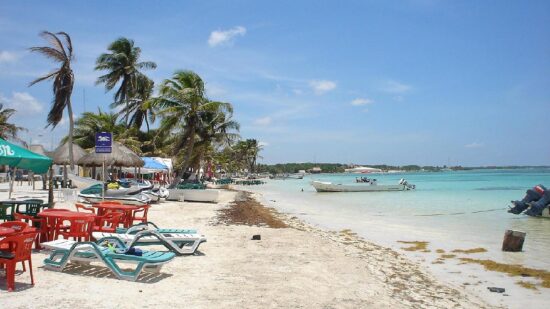
Cruise ships have turned Mahahual into one of Mexico’s busiest Caribbean port stops, but residents and researchers say the boom has delivered far less to the town than promised. As cruise traffic grows, Mahahual is being left to absorb the environmental damage, infrastructure strain and economic leakage that come with a tourism model designed to keep most of the profits onboard, according to El Pais newspaper.
El Pais describes the Quintana Roo town as a vivid example of how the cruise business can enrich a handful of global operators while leaving local communities with the long-term costs. Puerto Costa Maya opened in 2001, and more than two decades later Mahahual, a town of roughly 2,600 people, is dealing with deteriorated roads, chronic power outages, weak infrastructure and waste-management problems.
The recent fight over Royal Caribbean’s planned Perfect Day Mexico project near Mahahual brought those grievances into sharper focus. Residents and environmental advocates argued that the project would deepen the same private-destination model that already keeps much of the cruise spending away from the town itself. In May, Mexico blocked Royal Caribbean’s project on ecological grounds, turning what began as a local fight into a national story about who really benefits from cruise expansion.
The money question is central to the debate. Researchers cited by El País said that the average cruise passenger in Mexico spent about $85 in 2025, compared with roughly $1,200 for an international tourist. That gap helps explain why Mahahual residents see ships arriving in huge numbers without seeing anything close to the same scale of local prosperity.
Cruise ships are built to function as floating destinations, with food, drinks, entertainment and shopping already bundled into the experience. By the time passengers step ashore, there is often little reason — and not much time — to spend freely in town.
The environmental costs are harder to hide. Mahahual sits beside coral reefs and mangrove systems that are home to hundreds of species. Critics say cruise development has piled new pressure onto an already fragile area. El País reported that a mid-sized cruise ship can emit roughly as much greenhouse gas as 12,000 automobiles, while one day of wastewater from a cruise liner can reach more than one million liters.
For residents already dealing with sargassum, degraded local services and fears over reef damage, the question is no longer whether cruise tourism brings people, but what those visits actually leave behind.
The structure of the industry also matters. An academic analysis published in 2020 described cruise tourism in Mexico as an activity capable of generating significant revenue, but only at considerable environmental cost. The same research argues that the sector operates as an oligopoly dominated by a few holding companies, leaving destinations with limited leverage when ports become dependent on cruise calls.
That dynamic will sound familiar to longtime CLN readers. In 2012, we wrote about Falmouth, Jamaica, another Caribbean port where cruise-driven development was accused of enriching the operator while doing far less for the surrounding town than originally promised. Mahahual now appears to be facing a similar reckoning, with the added pressure of coral ecosystems, mangroves and a growing backlash over environmental limits.
And the ships are still coming. Mexico received 4.8 million cruise passengers in the first four months of 2026, a 14.8% increase over the same period last year, according to tourism data cited by the Mexican Press Agency. Those numbers make Mahahual more than a local dispute. They make it a test case for what happens when cruise growth keeps accelerating while the towns beneath it continue to ask what, exactly, they are getting in return.
Have a comment or question? Please leave one below or join the conversation on our Facebook page.
Image credit: Luyten~commonswiki